If you’ve been following my posts at Totnes Gardening, you’ll know I’m a big advocate for the "early risers." Whether it’s talking about Snowdrops in our local rewilding projects or the importance of Bee Bricks in our Devon stone walls, the goal is always the same: making Totnes a sanctuary for our pollinators. 🏡
Today at work, the garden was performing a symphony. While the rest of the borders are still waking up, the Winter Heather (Erica carnea) was absolutely teeming with life. Seeing Queen Buff-tailed Bumblebees on a single plant really drives home how essential this resource is right now.
In this video, I’m watching Queen Buff-tailed Bumblebees (Bombus terrestris) fueling up on Winter Heather (Erica carnea). This plant is a total lifesaver during the "hunger gap"—that crucial time in late winter and early spring when nectar is scarce in our Totnes gardens.
Why Heather is the Totnes "Hunger Gap" Hero
In the Totnes area, heather is an essential, early-season nectar source for our bees. It provides crucial nourishment in late winter and early spring—a time we call the "hunger gap," when other flowers are still scarce.
Looking at the footage I snapped today, you can see why I'm such a fan:
The "Fast Food" Station: These Queen Bumblebees are emerging from hibernation and need high-energy fuel immediately to survive and start their colonies.
Local Resilience: Heather is perfectly suited to our South Devon climate, providing a reliable food source even when the weather is hit-or-miss.
The "Hum" Factor: It’s one of the few plants that can turn a quiet March morning into a buzzing hive of activity.
Kevin’s Tip: If your Totnes garden is looking a bit quiet this month, tucking some winter heather into a sunny corner or a pot is the fastest way to invite the neighbors (the fuzzy, winged kind!) over for a visit. 🐝
Let’s Keep Totnes Buzzing!
Next time you’re out and about, stop and listen to the heather. That hum is the sound of spring arriving in Devon.
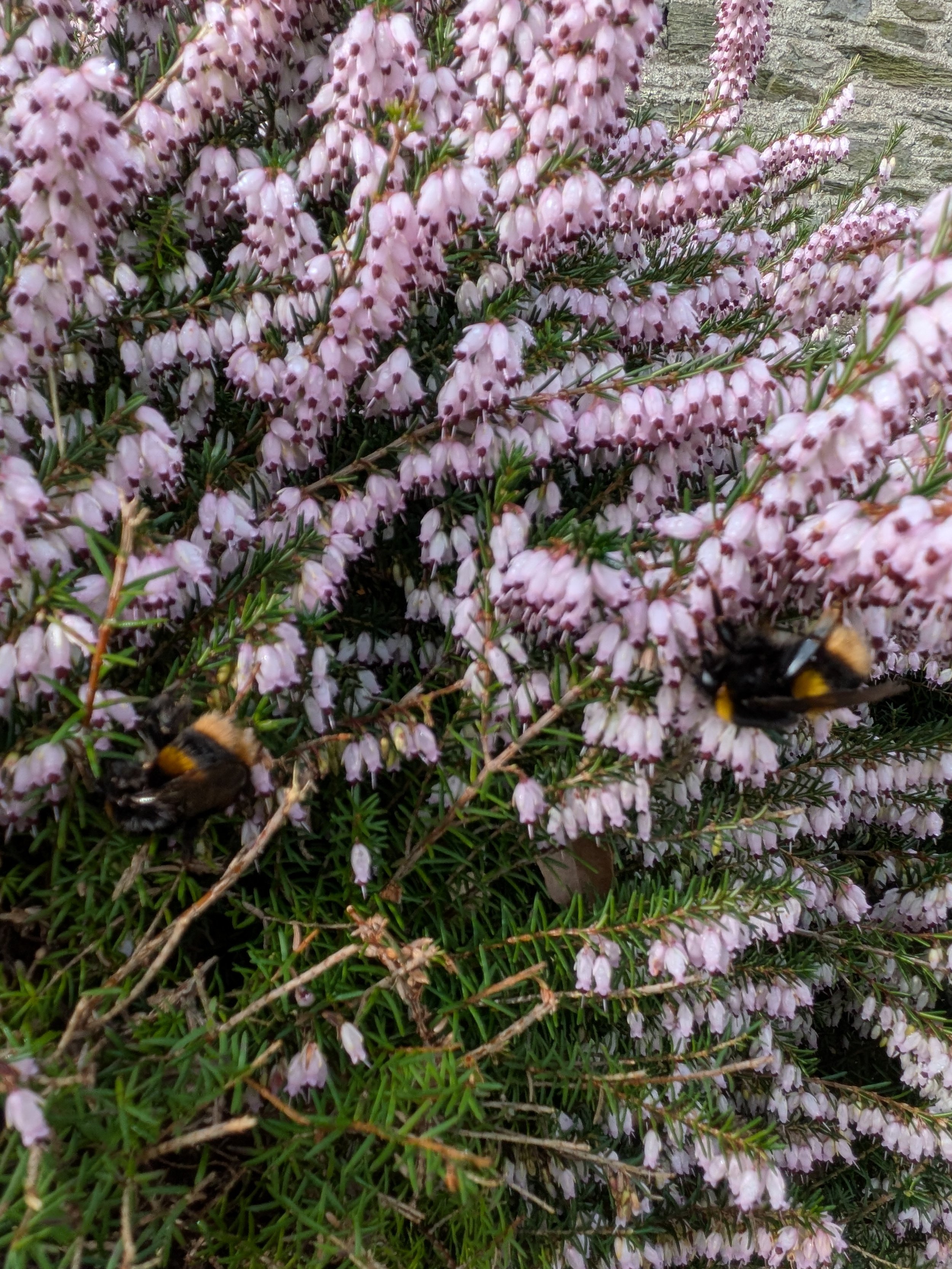
Early Spring Bees on Heather in Totnes 🐝🌸
Key Characteristics and Behavior
Appearance: Queens have a distinct, dirty-yellow or buff-colored tail, which distinguishes them from the white-tailed workers. They have yellow bands on the thorax and abdomen.
Size: They are the largest bumblebees in the UK.
Emergence: They are one of the first species to emerge from hibernation, often seen in February or March.
Diet & Behavior: They are "nectar robbers," using their short tongues to bite into the base of deep flowers, such as Comfrey or Runner Beans, to reach the nectar.
Nesting: They nest underground, often in abandoned rodent holes, and can have large colonies of up to 600 workers.
Life Cycle
Spring: Hibernating queens emerge to forage and locate nesting sites.
Summer: The queen produces workers, and the colony grows.
Late Summer/Autumn: New queens and males are produced, and young queens mate before finding a spot to hibernate for 6–9 months.
Survival: During hibernation, they can lower their body temperature to match the surrounding soil, relying on fat reserves to survive.
Identification Tips
Queen vs. Worker: The queen's tail is a "dirty" or buff color, whereas workers have a cleaner, white-looking tail.
Similar Species: They are often confused with the White-tailed bumblebee (Bombus lucorum), but the Buff-tailed queen has a more golden yellow band, while the White-tailed has a lemon-yellow band